
The glass is hard, rigid, capable of resisting a blow, and still lets light pass through as if it were not there. This apparent contradiction is not resolved by looking at the gaps between its atoms, but by asking what happens to its electrons when a photon arrives.
Being solid does not mean being opaque. Opacity does not measure the hardness of a material, but something else: what frequencies of light it absorbs and how much it deflects the rest. A brick and a sheet of glass are both solid, but they interact with light in opposite ways. The difference is not in how full or empty each one is, but in an invisible architecture that quantum mechanics describes.
The light does not filter through the gaps
The intuitive image is tempting and wrong. We think that light passes through glass because there are empty spaces between its atoms through which it manages to sneak in. If this were the case, any solid with holes would be transparent, and it is not. The metal also has distances between atoms and is completely opaque.
Transparency depends on how photons interact with the material’s electrons, not its empty spaces. Visible light occupies a wavelength range of approximately 400 to 700 nanometers, which corresponds to energies of about 1.8 to 3.1 electron volts. That energy is the currency with which a photon tries to negotiate its passage through matter.
The result of this negotiation is decided by the energy structure of the electrons. And that is where classical physics stops working.
A step that visible light cannot climb
The electrons of an atom cannot have any energy. They only occupy certain permitted states, separated by concrete differences, like rungs on a ladder with no intermediate positions. For an electron to absorb a photon and move up the rung, the energy of that photon must match the distance between two available states.
In silica, the main component of many glasses, this distance is large. Its electrons need significantly more energy than a visible photon carries to jump to higher states. The photon arrives, does not find a step that suits it and, since it cannot be absorbed through that path, it continues its path through the material.
In other words: visible light does not pass through the glass because it finds a gap, but because it does not have the means to pay for the jump. That same logic anticipates something that we often overlook, and that is that glass does not treat all radiation equally.
Transparent does not mean invisible to everyone
Regular glass can be quite transparent to the light our eyes see while absorbing other regions of the spectrum. More energetic photons, as part of ultraviolet radiation, do find available electronic transitions and are retained. Something similar happens in certain areas of the infrared, where the response of the material changes depending on the wavelength.
It is worth staying with this idea, which is one of the most useful concepts for understanding materials: transparency is selective. Glass functions as a spectral window, a specific range of frequencies in which it interacts little with radiation, while blocking or filtering others. To an ultraviolet-sensitive camera, that same glass might appear almost opaque.
And there is still another factor that has nothing to do with the energy of the photons, but with the way the atoms are arranged.
The ordered disorder of glass
Ordinary glass is an amorphous solid. Its atoms are firmly united, but they do not form the periodic, repeating network of a crystal. There are no grains, no domains, no internal borders that break the continuity of the material. This absence of an ordered crystalline structure has a direct optical consequence: there are few points where light can be deflected.
The uniformity of the glass means that it scatters little light, so it forms sharp images instead of a diffuse glow. Here it is convenient to separate two processes that we usually confuse. Absorption removes light, converting it into internal energy of the material. Dispersion does not eliminate it: it diverts it, distributes it in many directions. A path serves as an analogy. Absorption removes travelers from the route; Dispersion sends them to secondary roads. The analogy ceases to be valid as soon as scales have to be specified, but it establishes the difference well.
Just because a material is amorphous does not mean absolute chaos. It means that it lacks the periodicity of the crystal, not the cohesion. And this lack of periodic order, far from clouding the glass, contributes to the visible light passing through it without getting lost along the way.
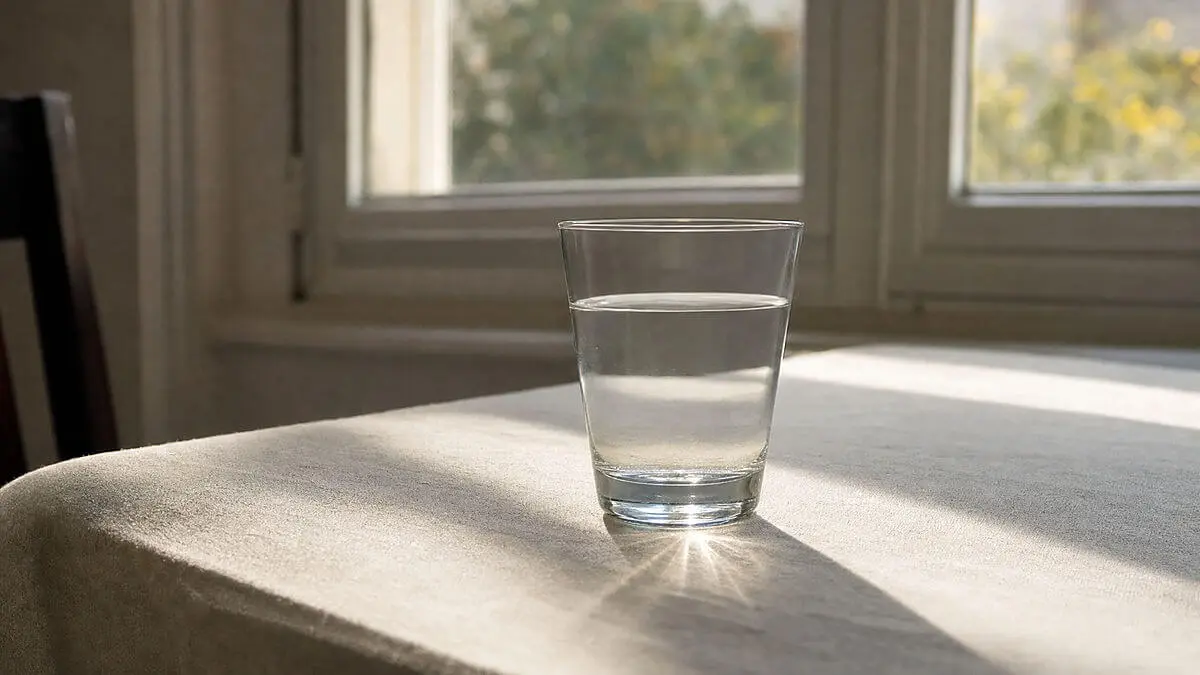
When the glass turns cloudy
If uniformity is the key, any irregularity should ruin it. And so it is. Trapped bubbles, microcracks, impurities, or a frosted surface introduce local changes to the material that bend light in many directions at once.
The result is translucent or cloudy glass. The interesting thing is that this loss of clarity does not necessarily mean that the material absorbs more light. A frosted glass lets a good part of the radiation pass through, but it does not form an image because it disperses it before it reaches the other side in order. The light comes out, but disorderly.
This also explains why it is advisable to distrust the idea of total transparency. No sheet of glass transmits 100% of the light it receives. Some of it is reflected on its surfaces and another changes direction as it enters and leaves the material. Transparency is a balance between what passes, what is reflected and what is absorbed, never a free and complete passage.
What is still being measured
The transparency of glass to visible light is well understood, but it stops being a closed question as soon as we change frequency or structure. There begins the terrain where the investigation remains open.
An example is terahertz waves, a radiation located between microwaves and infrared. There is recent research into how certain glasses respond to that region of the spectrum. They do not explain visible transparency, but they serve to remember that the interaction between radiation and matter changes with frequency: a material can be a window for some waves and a wall for others.
Another front is glass-ceramics, materials that incorporate crystalline phases within a glassy matrix. By mixing crystalline order and amorphous disorder, its mechanical and optical response shifts, and the question stops being whether a material is solid and becomes a finer one: what size are its internal heterogeneities and how do they compare with the wavelength that you want to transmit.
That’s the real design problem. It is not enough to choose a hard material or a transparent one, because both things depend on different variables. The open question is how to adjust the microscopic architecture of a glass so that it offers a clean window to radiation that it currently absorbs or disperses, and whether that fine control can be achieved without sacrificing resistance which, after all, is what first made us think that something so solid should not be allowed to pass through.