
A gecko runs upside down across a window without slipping or leaving a trace, and a Velcro strip opens and closes a thousand times without losing strength. Neither of them uses a drop of adhesive. How do they get it?
Same question, two answers
Intuition tells us that, for something to stick, a viscous substance is needed. The velcro and the gecko prove that this is not the case. Both adhere to a surface and release at will without glue, but they solve the problem with mechanisms that barely resemble each other: one hooks fibers, the other multiplies microscopic contacts.
The usual comparison, “glue or no glue,” falls short. The useful distinction is another: engagement versus contact. Velcro requires one piece to penetrate another and be retained. The gecko doesn’t fit at all; what it does is Extremely increase the actual surface area that touches the glass. Understanding that difference is understanding why one is a hardware store invention and the other, a physics problem that is still being discussed.
Hooks Seeking Loops
Velcro is actually the name of a brand that has become synonymous with one type of closure: hook and loop. Its operation is purely mechanical. One of the strips is covered with small rigid hooks and the other with soft, curved loops. When pressed against each other, the hooks slip between the loops and are trapped by pure geometry.
There is no adhesive chemistry between the two sides. The force that keeps them together comes from the shape and resistance of the framework. That’s why when you pull the strips apart, you hear that distinctive sound: you’re ripping off thousands of individual hooks at once. To use it again, just press again, because the hooks return to their position.
It is an effective, reversible and clean system, but it depends on the two surfaces being prepared beforehand. Velcro only attaches to velcro. A gecko, on the other hand, clings to almost anything, and that’s where the physics gets interesting.
Half a million hairs on each foot
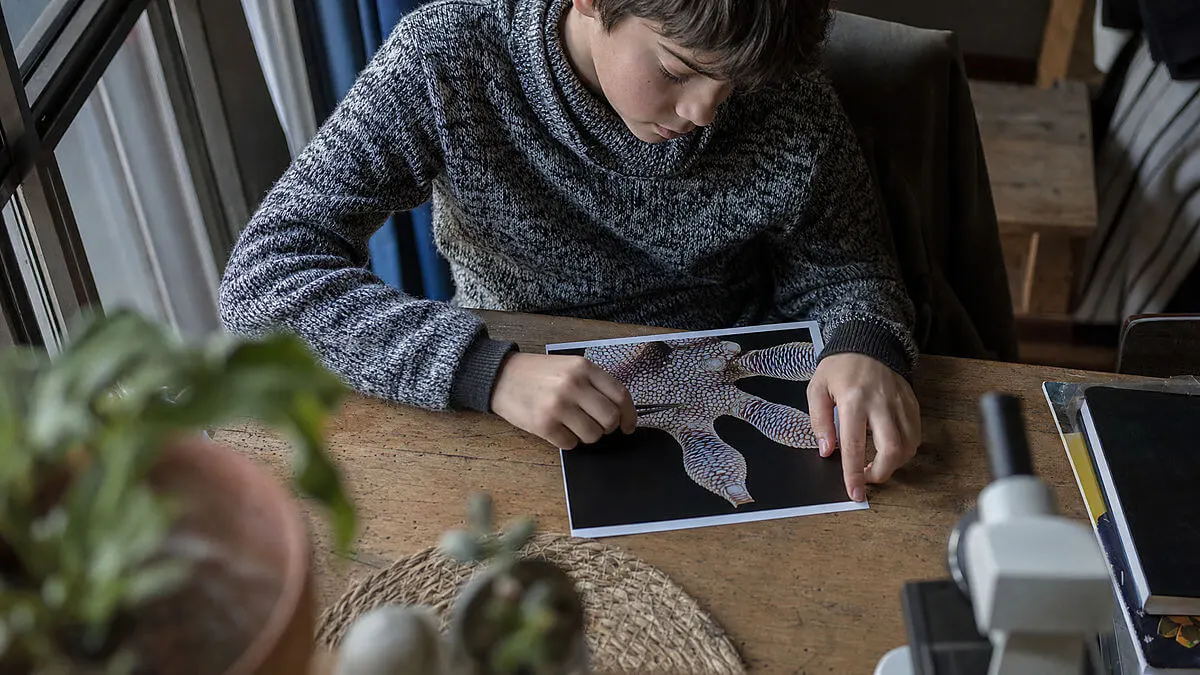
The gecko’s toes do not have hooks or suction cups. They are covered in mushrooms, microscopic hair-like structures that, in turn, branch into even finer ends.. The Kellar Autumn team described this architecture in 2000 and estimated that a single foot can gather about 500,000 mushrooms.
The figures help to dimension the scale. Each mushroom measures between 30 and 130 micrometers, that is, fractions of a millimeter. And their terminal tips are even smaller, about 0.2 to 0.5 micrometers. This extreme branching is the key: it turns what appears to be a smooth cushion into a multitude of tiny support points, capable of conforming to the irregularities of a surface that, at its scale, are mountains.
This precision to translate biological mechanisms into manageable images is part of the work of scientific dissemination, because the phenomenon is not understood by counting hairs, but by understanding what happens when those tips get close enough to a crystal.
Forces so weak that, one by one, they are useless
What keeps the gecko stuck is not latching or suction, but van der Waals forces: very weak physical interactions that appear between molecules when they are extremely close. They are so faint that, taken one at a time, they are irrelevant. Nobody holds on to a wall with just one of them.
The trick is in the sum. When half a million branching mushrooms bring their tips close to the crystal, the number of molecular contacts skyrockets to colossal numbers. Each one provides a tiny force, but the whole generates an adhesion capable of supporting the weight of the animal. A good image is of a key that opens not one lock, but millions of tiny molecular locks at the same time, each easy to defeat separately and almost impossible to defeat all at once.
In 2002, Autumn and her collaborators took this idea to the laboratory and provided experimental evidence that gecko adhesion is dry and is explained by these forces, without the need for any sticky film. The intuition of the viscous adhesive was disproved: to get a strong hold, sometimes it is enough to control the distance and multiply the contacts.
The problem is not sticking, it is detaching
Here appears the most striking property of the system, and the one that distinguishes it from any glue. A conventional adhesive has an uncomfortable defect: if it sticks well, it is difficult to peel it off, and if it peels off easily, it sticks poorly.. The gecko cannot afford this dilemma, because with each step it needs to hold on, support its weight and let go without getting trapped, and repeat it several times per second.
The solution lies in the geometry of the contact. Van der Waals adhesion depends on the setae being oriented and pressed in a specific way. The gecko controls this contact by changing the angle of its fingers: when it reorients its paw, the tips are no longer in the position that favors union and the grip is undone almost effortlessly. The same architecture that sticks is what allows it to take off.
That is why the animal unfolds and curls its fingers in such a characteristic way when walking on a vertical surface. You are not pulling with brute force to remove the leg; You are reconfiguring the contact so that the adhesion force disappears just when you need it to disappear. The velcro opens by separating strips; the gecko, changing angles.

What is not yet closed
The explanation based on van der Waals forces has strong experimental support, but it should not be presented as the last word in all situations. The role of microscopic humidity, the possible presence of very thin films of water between the mushrooms and the surface, has been debated. It is not resolved to what extent it contributes to adhesion depending on the material on which the animal walks or the environmental conditions. Observing the mechanism of the gecko is also an exercise in animal behavior where physics still leaves open questions.
The most tempting challenge is to copy it. Reproducing an isolated mushroom is not equivalent to reproducing a leg, because the gecko’s system combines flexibility, close contact, load capacity and controlled detachment. A dry adhesive inspired by these structures would have enormous appeal: sticking and detaching many times, without residue and without losing strength. Nature has been working it out for millions of years in every step of a gecko across the roof. The question that remains is whether engineering will one day achieve that same reversibility at will, or whether half a million hairs on a single foot will continue to be too difficult to imitate.