
In 1937, off the coast of Brittany, France, a puzzling phenomenon was described: Some people claimed to see the light of a lighthouse located out to sea, although there was none there. The extraordinary thing was that the witnesses were not confusing two constructions. The light existed, but it came from a real lighthouse behind them. Almost nine decades later, a team of scientists has found an explanation for this surprising optical illusion.
The phenomenon, known as ghost lighthouse illusionhas been observed in different coastal regions of the world. One of the places where it is most repeated is Lady Elliot Island, located at the southern end of the Australian Great Barrier Reef. There, visitors contemplate light beams at night that seem to emerge from a distant point on the horizon.
Interestingly, the island has two authentic lighthouses. The first was built in 1873 and stopped operating in 1995, when a more modern one came into service. However, tourists continue to describe the presence of a supposed third lighthouse that simply does not exist.
Now, research published in the scientific journal Open Mind: Discoveries in Cognitive Science proposes that this visual deception is not due to a light anomaly, but to the way our brain calculates distances. The study was developed by Charles Kemp and Simon J. Cropper, from the University of Melbourne, together with Weilun Xu, from the Federal Polytechnic School of Lausanne.
The strange phenomenon that makes lighthouses appear where there are none
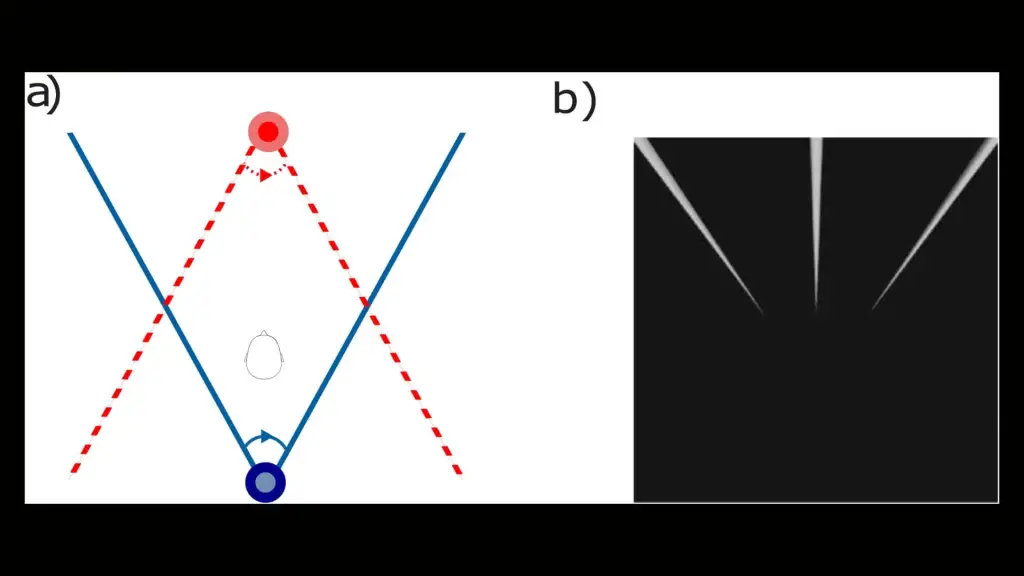
To experience this illusion, simply stand in front of the sea, at a certain distance from a lighthouse, and turn your back to it. When the light beam rotates above the observer’s head, it may appear to come from somewhere beyond the horizon.
What is truly disconcerting is that knowing the authentic location of the lighthouse does not prevent you from experiencing the phenomenon. Even if a person turns around and checks where the light is coming from, looking towards the sea again may give them the same wrong impression.
The scientific team decided to study this behavior using a mathematical model based on Bayesian inference, a mechanism that allows the information received by the senses to be combined with the expectations acquired through experience.
According to the authors, The work suggests that what people actually see is a combination of what they expect to see and the evidence their senses provide.
During the night, especially when we contemplate a practically dark sea surface, we have very few references to calculate distances. Given this lack of information, the brain resorts to its usual experience with much closer objects and may incorrectly interpret the position of the light beam.
The surprising explanation that our brain offers
A lighthouse projects light that can travel enormous distances. When the mechanism rotates, the points further away from the beam physically move faster than those closer to it, because they travel in a much larger arc during the same time interval.
However, our perception can reverse this relationship. By underestimating the distance of the furthest parts, the brain interprets that they move more slowly than the nearest ones. Thus, the distant end seems to become the origin of the light movement.
This interpretation creates the impression of a light source located in front of the observer, when in reality it is behind. The researchers maintain that the same mechanism explains another known illusion: the sensation that some headlight beams curve towards the ground, despite projecting practically parallel to it.
But there was one pending question. If this explanation was correct, it should be possible to determine at what distance the illusion begins to manifest. And here one of the most interesting results of the research appeared.
The calculations indicated that, for a lighthouse 30 meters high, the critical point should be approximately 67 meters from the observer. For constructions of 34 and 38 meters, the predictions increased to 78 and 89 meters, respectively. They are not universal distances, but results dependent on the characteristics of the model and the environment.
A virtual reality experiment puts the mystery to the test
To test their predictions, the scientists recreated the phenomenon using a virtual reality environment developed with Unity and Meta Quest 2 glasses. In it they simulated a 30-meter lighthouse and allowed participants to observe the movement of its beam from different positions.
31 people initially participated in the experiment, although one was excluded from the analysis. The main measurements of the ghost headlight illusion were therefore carried out with 30 participants.
The results supported the existence of a critical distance. One of the experimental procedures placed its median at 75 meters, while another established it at 112.5 meters. Although the figures did not exactly match the 67 meters predicted, they offered support for the general hypothesis.
The researchers also found that participants needed to look at a beam tilted slightly upward to perceive it as horizontal, reinforcing the proposed explanation for the illusion of apparently curved light.
The experiment has its limitations: the recreated beams looked like luminous cylinders with defined edges, not real lights dispersing in the atmosphere. Furthermore, the results come mainly from virtual simulations, so controlled outdoor testing would still be useful.
The mystery, in any case, points to a fundamental characteristic of our perception. The brain does not simply register what is in front of it: it continually interprets the available information. And, in certain circumstances, this mechanism that normally helps us understand the world can make us see a lighthouse in the middle of the ocean that was never there.