
Imagine that you carefully scrape the iris of a blue eye and observe it under the microscope in search of that light blue pigment. You won’t find it. No matter how hard you try, there is no blue ink stored in the eye. And yet, we see it blue. How is this apparent contradiction explained?
The key is not only in the biology of color, but in how light behaves when passing through a tissue. The blue of the eyes is, above all, an optical phenomenon. To understand it, we have to look at the architecture of the iris and remember something we learned in physics class: light does not always behave as we think.
The iris is not a sheet of color, but a layered tissue
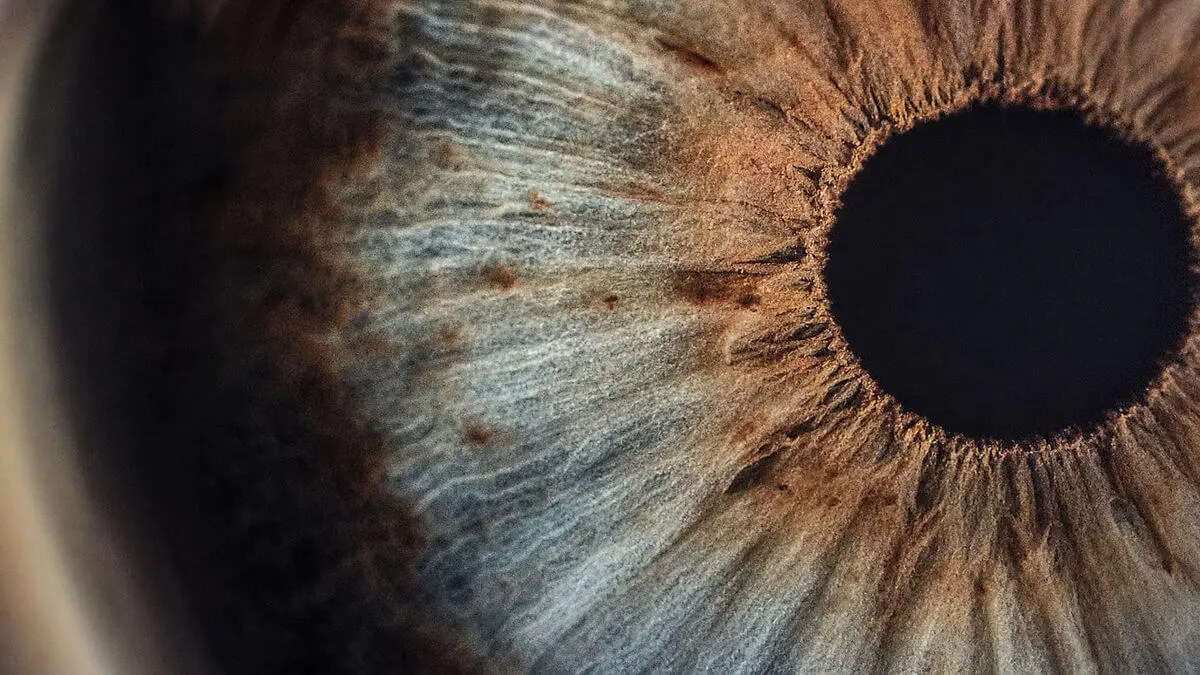
The first intuitive error is to imagine the iris as a painted surface. It is actually a multi-layered structure. In the front part we find the anterior limiting layer and the stromaa connective tissue made up of collagen fibers and cells. At the back is the pigment epithelium, a layer highly loaded with melanin that performs an absorption function.
Melanin, the same pigment that darkens skin and hair, is present in all irises. What changes from one person to another is not their total presence or absence, but their quantity and distributionespecially in those front layers. And there the enigma begins to be solved.
Little melanin: the starting point of blue
In blue eyes there is little melanin in the anterior limiting layer and in the stroma. That detail changes everything. Melanin absorbs part of the light that reaches the eye, so when there is a lot of it, as in brown eyes, a good part of the spectrum is retained and we perceive a dark color.
When melanin is scarce in the anterior layers, light penetrates further into the tissue and encounters the complex network of collagen fibers in the stroma. It is at that point where physics takes an important role. According to scientific reviews on iris optics (Sturm and Larsson, 2009; Rennie, 2012), the blue we see is a structural colornot the result of a blue pigment.
What does light actually do inside the eye?
Here it is important to be precise, because popular explanations tend to oversimplify. It is not correct to say that the iris absorbs all colors except blue, nor that other wavelengths simply “bounce.” What happens is more subtle.
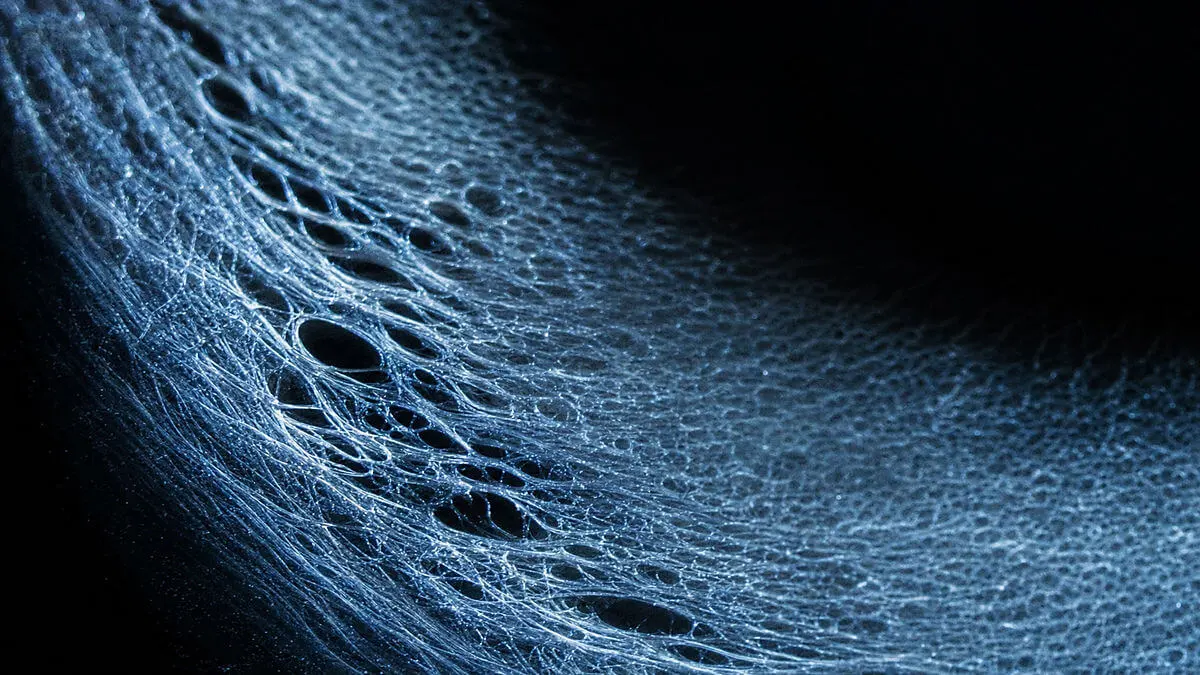
When light enters a poorly pigmented iris, the matrix of stromal fibers disperses it. This dispersion does not affect all wavelengths equally: it tends to favor relatively more components of shorter wavelengths, which our visual system interprets as blue, and to allow other components to propagate differently within the tissue. Overall, the result for the observer is that more components arrive with a bluish appearance.
In other words: blue is not stored in the eye, it is generated when light passes through that structure. It is a real, perceptual color, but its origin is physical, not a dye deposited in the iris.
In other words: blue is not stored in the eye, it is generated when light passes through that structure.
And the famous Tyndall effect?
You’ve probably heard that blue eyes are due to the Tyndall effect, a term often used as a comparison to explain the scattering of light in media with structures that affect different wavelengths. The comparison is useful as a mental image, because it helps you understand that light can take on a bluish appearance when it is scattered. But it should be used with caution.
The Tyndall effect, in the strict sense, describes the scattering of light in a colloidal suspension, that is, particles dispersed in a medium. The stroma of the iris is not exactly that: it is a fibrous and solid tissue, much more complex than a homogeneous colloid. That is why specialists prefer a more cautious expression: Wavelength-dependent light scattering in iris tissue. Talking about “Tyndall-type” dispersion is a good informative abbreviation, as long as we do not take it as an exact physical identity.
The same caution applies to the typical comparison with the sky. The sky also appears blue due to a dispersion phenomenon, but it is not the same mechanism or the same medium as that of the iris. They are related phenomena, not identical. Equating them without nuances leads to wrong conclusions.
If there is no blue pigment, why does the color change with light?
Many light-eyed people notice that their color seems to vary depending on the lighting, the clothes they are wearing, or the environment. So does the melanin of the iris change from one moment to the next? No. What changes is the mix of light that reaches the observer.
As the amount and type of light that enters the eye changes, the proportion of scattered, absorbed and reflected light that we finally perceive also varies. That’s why the same blue eye can appear more intense on a sunny day and duller indoors. It is one more clue that we are dealing with a structural color that depends on physical conditions, not a fixed pigment.
The genetics behind color: neither simple nor a single gene
If the mechanism is optical, the next question is inevitable: what decides that a person has little melanin in the iris? The answer is in the genes, although it does not work as a simple “one gene for each color” formula either.
Eye color is a trait polygenic. According to MedlinePlus Genetics (2022), the gene OCA2 and a regulatory region located in the gene HERC2 They have a prominent role in the production and distribution of melanin in the iris. But they do not act alone: other genes contribute to intermediate combinations, such as green, hazel or gray tones.
Therefore, although OCA2 and HERC2 Although they are key pieces, they do not allow us to accurately predict the color of a specific person’s iris. The relationship between genetic variants and shades is complex, and science is still fine-tuning those details.
So, are blue eyes blue or not?
It is worth qualifying the provocative phrase with which this story usually begins. It is not entirely true that “blue eyes are not blue.” The precise thing is to say that they are not blue by a blue pigment. The blue we see is a real perceptual color, generated by the interaction between light and the structure of a poorly pigmented iris.
The precise thing is to say that they are not blue because of a blue pigment.
It is a good reminder that what we perceive does not always coincide with what an intuitive interpretation suggests to us. Where we expected to find chemistry, physics acts. And where we imagined a dye, there is an interaction between photons and collagen fibers.
There remain open questions that the research continues to explore. How much exactly do the dispersion of fibers, the absorption of melanin and other microscopic components contribute to each iris? To what extent will genetics one day be able to predict the specific color of eyes? Meanwhile, the next time you look at light eyes you can remember that you are not seeing a pigment, but an optical phenomenon.