
Proximity to a bonfire offers a simple intuition: as the distance reduces, the heat becomes more unbearable. If we replace the flames by a star whose surface is around 5,500 degrees centigradeit is possible to conceive of an invisible line from which any visitor would end up destroyed.
From this arises an almost childish question and, precisely for that reason, powerful: how close can something get to the Sun and return? Mercury provides a first reference. The planet completes one revolution in just 88 Earth days and, seen from our comfortable distance, it gives the impression of already inhabiting the edge of what is tolerable.
However, using it as a measure is misleading. Asteroids, probes and, above all, comets have penetrated much further into the solar domain. Some managed to get out; others fragmented or vanished.
To understand these outcomes, it is advisable to first abandon a seductive idea: there is no universal threshold around our star that equally annihilates everything that crosses it.
Before the record: what it really means to get close to the Sun
Planets and minor bodies do not necessarily trace perfect circles. Many orbits are ellipsesfigures similar to an oval, and the Sun occupies one of its focuses. Therefore, the separation from the star varies greatly during a single revolution. The point located the shortest distance receives a name: perihelion.
We can imagine an oval track in which the runner passes once by a bonfire placed towards one end and then walks away. A comet can remain for much of its journey in cold, remote places, accelerate as it falls toward the central regions of the Solar System, and briefly pass through a scorching sector before leaving again.
Mercury helps put numbers to that geometry. In its perihelion, It is about 46 million kilometers from the solar surface. The figure is small in astronomical terms. But when we descend the gradation of extreme cases, the world closest to our star quickly ceases to resemble a particularly daring neighbor.
A comet can remain for much of its journey in cold, remote places, accelerate as it falls toward the central regions of the Solar System, and briefly pass through a scorching sector before leaving again.
There are asteroids that leave Mercury behind
Some asteroids follow trajectories that cross the Mercury orbit. The pull of the planets can alter their itineraries for enormous intervals and send fragments originating further away to regions much closer to the Sun. They do not need to have formed in that neighborhood to end up visiting it.
A striking example is 2024 YL3, an asteroid of around 140 meters. Its perihelion takes it about 10 million kilometers from the solar core, much deeper than Mercury.. It continues to be a gigantic separation on our daily scale, but the jump with respect to the latter allows us to appreciate how much space there is still to the star.
Astronomers have even looked for a hypothetical population of small worlds called vulcanoids, capable of permanently orbiting inside Mercury. Certain fringes would be dynamically stable, that is, they would admit long-lasting revolutions without planetary disturbances immediately expelling their members.
So far, none have been confirmed. The nuance matters: the fact that physical laws make something viable does not prove that nature has managed to manufacture it.
Parker Solar Probe: a machine sent into the fire
Humanity decided to deliberately enter an even more hostile environment. NASA’s Parker Solar Probewas designed to directly study the outer atmosphere of the Sun. In its deepest forays, reached about 6.1 million kilometers of the visible layer, much closer than any previous ship.
How can a machine survive there? The answer requires distinguish temperature and heat transfer. The corona, an extremely tenuous envelope of the solar atmosphere, reaches more than a million degrees. However, it contains so few particles that it does not transmit energy as a dense material would at the same thermal level.
The corona, an extremely tenuous envelope of the solar atmosphere, reaches more than a million degrees, but contains so few particles that it does not transmit energy as a dense material would at the same thermal level.
The comparison with an oven helps. We can endure very hot air for a moment that would cause injuries much more quickly if it were water at the same degrees.because the liquid gives up energy more efficiently.
Besides, Parker Solar Probe Adds another defense: a carbon composite shield keeps your instruments in the shade while the exposed side resists brutal radiation. It is not invulnerability; It is engineering designed for very specific circumstances.
Then the comets arrive and break our scale
Grazing comets take the challenge much further. They are objects rich in volatile materials whose orbits take them extraordinarily close to the Sun.. Some belong to families that arose from the breakup of older ancestors and periodically return to the solar environment along routes that seem suicidal.
There are several simultaneous executioners. Heating causes the ice to turn directly into gas, a process called sublimation, and drags dust and other components. Thermal contrasts generate tensions. In addition, the solar attraction pulls with different intensity on the near and far flank, creating tidal forces that can contribute to breaking apart a fragile core.
Therefore, asking at what distance “an object” is destroyed is equivalent to asking how close we can get something to a bonfire before losing it. A steel ball, a frozen block, and a barely compacted pile of gravel will not react the same. Size, composition, cohesion, rotation, speed and exposure time determine the destination.
The comets They are especially vulnerable because they usually contain frozen substances and poorly consolidated matter. Still, some complete surprisingly close raids and continue on their way..
A steel ball, a frozen block and a barely compacted pile of gravel will not react the same: size, composition, cohesion, rotation, speed and exposure time determine the fate.
The comet that practically touched the Sun
One of the most extraordinary episodes occurred in 1887. The Great Southern Comet appeared as a brilliant low traveler and described a course so closed that its perihelion was about 718,000 kilometers from the solar center. The figure needs context to reveal how truly exceptional the encounter was.
The radius of the Sun—the length from its axis to the visible surface—is around 696,000 kilometers. That means that the comet circulated just a few tens of thousands of kilometers above the photosphere, the luminous envelope that we perceive as the surface.
Compared to the magnitudes handled until now, it was practically a brush. And, despite such a step, he escaped. But that outcome It does not establish a valid barrier for all comets: it describes what that protagonist achieved on that occasion.
In 1887, the Great Southern Comet described such a tight course that its perihelion was about 718,000 km from the solar center, just a few tens of thousands of km above the photosphere, and it escaped.
The episode shows precisely why the problem cannot be reduced to a magic number. Two visitors with different compositions, sizes or structures could face opposite endings even though they follow similar routes.
One more step: really enter the Sun
We can still conceive of a more radical trajectory. If the perihelion of a comet is below the solar radius, its path no longer runs over the visible surface: it passes through it. These hypothetical intruders receive names in English such as sundivers either sunstrikers. They would not simply be grazing comets, but masses thrown directly at the Sun.
Here an unequivocal geometric divide does emerge. A route that penetrates the photosphere physically penetrates in increasingly dense solar strata. Heating, resistance of the surrounding medium and disintegration they would make the possibility of emerging intact something radically different from an outside incursion.
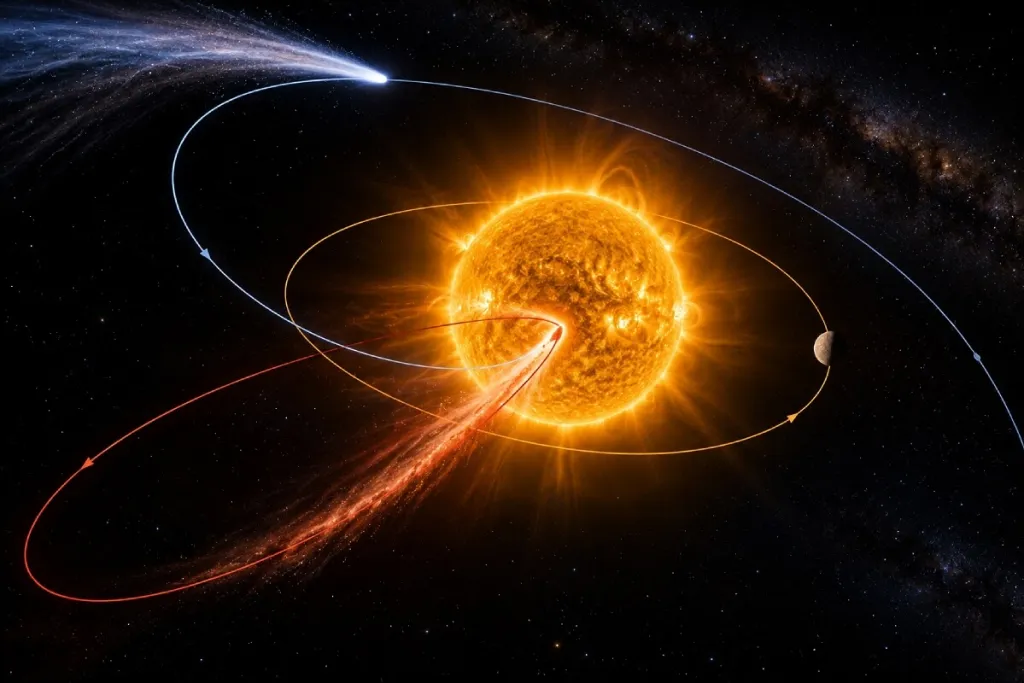
That does not, however, provide the number we may have expected at the beginning. Knowing where the edge of the Sun begins is not the same as determining where any approaching object will fall. Many comets can break up much sooner; others tolerate surprisingly deep approaches. The physical demarcation of the star is unique, but the future of the intruder depends on more factors.
So, at what distance does the Sun destroy an object?
The answer can now be formulated without tricks: there is no universal outer distance. The effect is determined by why it arrives, how it is constructed, and how it is approached. A compact rocky asteroid, a protected spacecraft, and a porous comet face different threats even if they share exactly the same perihelion.
Speed also matters. A fast transit limits the period during which radiation can deposit energy; A prolonged stay allows more room to heat, sublimate or fracture materials. The transfer distributes the contribution received in a different way. Internal cohesion establishes how much the structure will withstand stresses. Even guidance can modify which areas bear the brunt of punishment.
A compact rocky asteroid, a protected spacecraft, and a porous comet face different threats even though they share exactly the same perihelion; especially if it is at a different speed and rotation.
The initial question, therefore, was incomplete. It’s not enough to ask to what distance; hoh what to add qWhat object and under what conditions. Astronomy does not replace an unknown frontier with another exact figure: it discovers something more interesting, a range of possibilities governed by the interaction between each traveler and a progressively more hostile environment.
Getting closer to the Sun teaches something more important than a record
Our journey began with Mercury, which offered an intuitive definition of closeness. Then, we leave it behind with asteroids, accompany Parker Solar Probe inside the corona and follow comets capable of grazing the photosphere. Each step broke down the barrier that the previous one seemed to suggest.
This succession reveals a lesson that goes beyond astronomy. We tend to look for clear lines in nature: here the danger begins, from here nothing lasts. But many limits are linked to both the protagonist and the setting. An environment may be tolerable for one configuration and lethal for another..
Therefore, the record of the Great Southern Comet of 1887 is fascinating, although that record is not the most important conclusion. Asking how close something can get to the Sun seems to require a figure. In reality, it forces you to know the subject. Next to a star, preserving yourself depends not only on where you are, but also on what you are and how long you stay there.
