
We usually interpret emptiness as the absence of things. In quantum physics, it refers to something different: the state in which a field has the lowest possible energy. Although there is a complication: it may seem that you have reached the lowest level and there is, in reality, an even deeper level. Our universe may be in a stable configuration and yet there may be another with a lower energy.
That transforms an almost philosophical dilemma into a challenge for physicists: Why does the cosmos remain in the known state if quantum laws contemplate a transition between configurations?
The most famous example is the Higgs field, a quantum field that permeates the entire universe and is related to the origin of the mass of elementary particles. By extrapolating the Standard Model—the theory that describes known particles and the forces that act between them—to enormous energies, some estimates indicate that our electroweak vacuum would be metastable, although its expected lifespan vastly exceeds the age of the universe.
But that approach rests on a conceptual concession. The fields do not operate alone: they coexist with other entities, fluctuations and, necessarily, with gravity. A group led by the University of Portsmouth has proposed how the situation changes when the field is no longer considered isolated and its interactions with other quantum fields are taken into account.
Before seeing his response, published in the scientific journal Journal of Cosmology and Astroparticle Physicsit is worth clarifying how a field can become trapped in a vacuum and what would have to happen for it to move to another.
The void is not as empty as it seems
Let’s imagine a landscape with two valleys divided by a mountain. A ball placed in the lowest depression would end up at the minimum energy level: that image represents the so-called true vacuum. If you stop at the shallowest depression, we get a simple metaphor for false emptiness.a situation capable of prolonging even if there is an even more energetically favorable state.
In classical physics, the sphere would require quite a bit of momentum to climb up the slope, but quantum mechanics opens up a much less familiar path. A particle or a field has a non-zero probability—it exists, even if it is ridiculous— of overcoming a barrier forbidden by classical intuition. It’s the tunnel effect. That doesn’t literally mean punching through any walls: it expresses a concrete possibility of transition between configurations that ordinary rules wouldn’t link in that way.
If a field trapped in a false vacuum were moved to another with new characteristics, the constants, masses or interactions of matter would vary.
On a cosmic scale, the hypothesis acquires major consequences. If a field trapped in a false vacuum were moved to another with new characteristics, the constants, masses or interactions of matter would vary. The ball only helps to visualize it: what fills the valleys is a quantum field extended throughout the universe.
The difficulty of conceiving an isolated universe
The decay of the false vacuum has been under scrutiny for decades. Sidney Coleman and Curtis Callan formalized the tunnel between voids; later, Coleman and Frank De Luccia added gravity; In turn, Stephen Hawking and Ian Moss addressed transitions in de Sitter space, an idealized geometry that describes an acceleratingly expanding universe.
However, this approach portrays the central field as a closed system. Robson Christie and his collaborators raise a direct objection: such isolation from the rest has no equivalent in cosmology. A field coexists with other degrees of freedom—independent ways in which a system admits variations—and these couplings reconfigure its quantum behavior.
At this point enter decoherence. The word designates the decrease in the ability of quantum alternatives to interfere with each other when information about them is dispersed into the environment. It does not require a person observing, nor a consciousness that magically “collapses” anything. Physical contact is enough.
So, overlapping options begin to manifestfor practical purposes, as distinguishable results. The doubt then becomes inescapable: if the environment undoes this interference, what happens to the tunnel that connected the two valleys?
A laboratory universe with two destinies
To explore it, Christie and his colleagues designed a manageable cosmos. His scheme places a scalar field—a magnitude with a value at each position—in a space of Of Sitter. The potential, that is, the energy map that marks where it tends, brings together two unequal minimums with a barrier between them..
The study also incorporated a series of “spectating” scalar fields. They are called that because They participate as an environment without dominating the expansion of the analyzed scenario. With various couplings between these ingredients, the team followed how environmental actions modulated the behavior of the main field as the simulated universe expanded.
Mathematical machinery includes Markovian and non-Markovian master equations: in plain language, distinguish whether the future is described without significant memory of the past or whether that previous experience leaves a trace. Then, they solved them on the computer. Two unknowns remained: in which valley the field would end and if later he would be able to abandon it.
The environment does not choose emptiness; does something more curious
The first finding prevents a tempting reading. Increasing coupling with the environment and causing decoherence barely changes the probability that the field ends up in one vacuum or another. That connection does not act as a referee pushing the field toward the true void and away from the false one.
Increasing coupling with the environment and causing decoherence barely changes the probability that the field ends up in one vacuum or another.
The crucial factor is the relationship between the mass scale of the field and the Hubble rate, which measures the rate at which the universe is expanding. When that one is heavy By comparison, evolution is adiabatic: it proceeds smoothly, so that the system closely follows its instantaneous state of minimum energy. In these computational tests, that regime leads in most cases to true emptiness.
With lighter fieldsanother panorama is emerging. The path usually adopts a non-adiabatic character, which increases the fraction corresponding to the false vacuum, so that the system preserves an appreciable probability of settling in the upper valley.
Until that moment, decoherence has little influence on the final distribution. Its decisive role is revealed in the next stage.
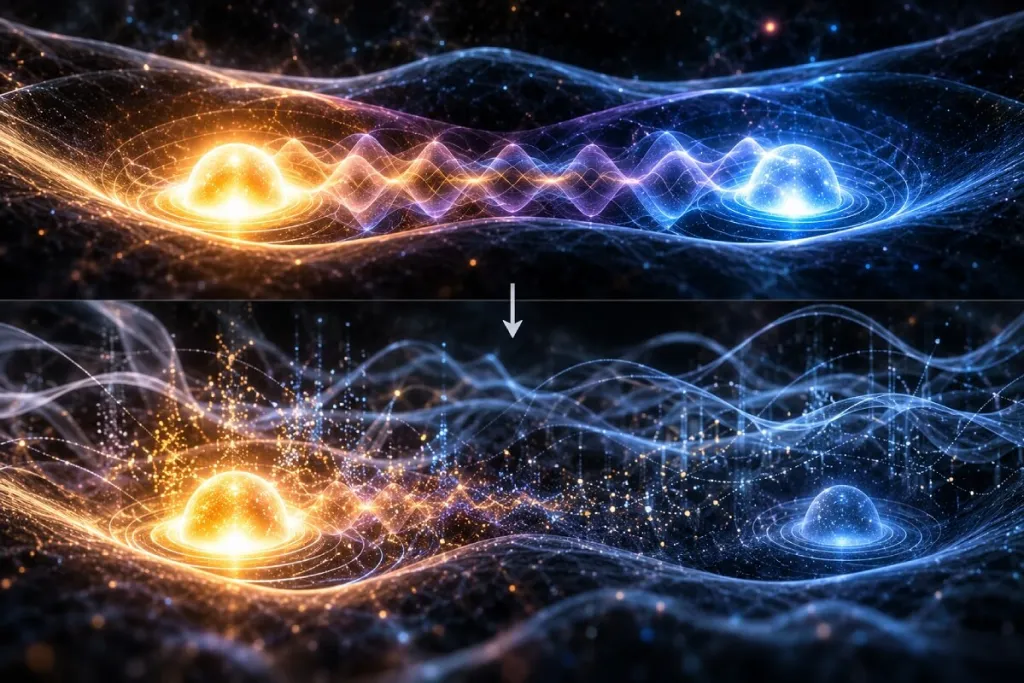
Once the field has been located at one of the minima and the interference between the two has vanished, the tunnel experiences strong suppression: the environment prevents the system from later passing through the barrier and migrating to another void.
Once the field has been located at one of the minima and the interference between the two has vanished, the tunnel experiences strong suppression. The environment prevents the system from later crossing the barrier and migrating to another void. The authors call this fixation cosmic lockdown“cosmic lock”: it does not so much decide the room as it contributes to locking it when the tenant is already inside.
The Quantum Zeno Effect: When Surveillance Means Immobilization
The explanation refers to quantum effect of Zeno (or Turing’s paradox). Its name alludes to the philosopher from Elea, although on this occasion no unattainable turtle intervenes. In certain systems, a repeated measurement or a sustained interaction with the environment inhibits a transition that would have occurred if quantum dynamics had run its course without that intervention external.
“Watching” does not mean that someone watches the field from outside the universe. The environment records information about it and modifies conditions in which a coherent superposition could persist and overcome the barrier. This monitoring is physical, not psychological.
The balance does not automatically tip towards the true vacuum: if the previous phase places the field in the false one, it is retained there because the cosmic blockade does not show preferences; strengthens the chosen minimum.
Let us now return to the two valleys. At first, Our quantum ball had a power foreign to a classical object: materializing on the other side of the mountain through a tunnel. After decoherence, this link with the environment drastically narrows that escape route. The landscape does not need to build an additional wall; what is altered is the process responsible for the crossing.
A counterintuitive outcome then appears. This effect does not automatically tip the balance toward true vacuum. If the previous phase places the field in the false, it is retained there. The cosmic blockade does not show preferences: it reinforces the chosen minimum. Therefore, its relevance to understand the survival of metastable states, not as a guarantee that nature always ends in the state of minimum energy.
Cosmic lockdown is no insurance against the apocalypse
In this section, it would be easy to go beyond what its conclusions authorize. Christie and his colleagues have not shown that the quantum Zeno effect is protecting our electroweak vacuum, nor that they have definitively resolved the stability of the universe. Its construction offers a deliberately limited theoretical framework, aimed at unraveling this phenomenon and tracing its derivations.
Among his approaches, the fields appear as spectators in a space of De Sitter and its feedback on geometry is neglected: its development is examined without taking into account its substantial effect on space-time. Researchers also use a fixed comoving volume—a region defined to accompany the expansion of the universe—and other necessary idealizations.
The Higgs field serves, therefore, to show why this problem matters, not as proof that the effect considered governs its real future. Translating this idea to the physical universe will require more exhaustive formulations. The interest is in another site: points out that an evaluation of transitions between voids runs the risk of being incomplete if it ignores the decoherence caused by its environment.
The novelty is not the future of the universe, but another perspective
The initial impression invited us to think about stability as a question of the energy landscape. How deep is each valley? What is the energetic height of the barrier? With what probability would a field cross it? They are essential questions, but this work adds another: what are you interacting with while all this is happening?
There emerges a shift in perspective. In quantum mechanics, knowing the properties of a system does not in itself guarantee anticipating its trajectory if the environment is omitted. Couplings with other degrees of freedom erase interferences and, according to these numerical calculations, even eliminate transitions that seemed available when the protagonist was treated separately.
Thus, we return to the concern of the beginning with a renewed scene. The ball continues in front of two valleys and a mountain, but it no longer floats in an empty set, but is immersed in a universe that maintains links with it. Perhaps the key is not just why it doesn’t cross the barrier, but how much we lose sight of by projecting its fate as if nothing surrounded it.
