
More than 120 million years ago, an unusual dinosaur roamed the territory that today occupies northeastern China. It walked on two legs, had an elongated neck, dozens of small teeth clenched in its jaws, and hands topped by large claws. Its appearance must have been as peculiar as that of other members of its family: the Therizinosaurus, one of the most puzzling groups among theropod dinosaurs.
Now, an almost complete skeleton recovered in the Yixian Formation, in the Chinese province of Liaoning, has made it possible to identify a genus and species previously unknown. Paleontologists have named it Kayrasaurus changliensisand it is not exactly a small specimen. It exceeded 3.6 meters in length and researchers calculate a body mass of between 117 and 274 kilograms. It is also the largest therizinosaur known to date in the famous Jehol Biota.
The discovery has been presented by Chun-Chi Liao, William J. Freimuth, Lindsay E. Zanno and Xing Xu in Journal of Systematic Palaeontology. The fossil preserves a large part of the skull and jaw, a good part of the spine and the forelimbs. The hind legs are missing, however. The condition of some bones further indicates that the animal had not yet fully reached skeletal maturity when it died.
A dinosaur that looks like it was made from parts of different animals
Therizinosaurus have been puzzling paleontologists for decades. They were maniraptor theropods—the great lineage that also includes birds—but some of their most evolved representatives developed an anatomy that was far from the usual image of a carnivorous dinosaur. They had relatively small heads, long necks, robust bodies, wide pelvises, and enormous fingernails.
Their combination of characteristics was so strange that the group’s evolutionary position remained surrounded by controversy for years. The first fossils were even interpreted as remains of giant tortoises and, later, other affinities were proposed before new skeletons made it possible to place them among the theropods.
Kayrasaurus Now add another piece to that story. The specimen is especially striking due to its size: the authors calculate that it was approximately 1.6 times longer than the holotype of Beipiaosaurus inexpectusso far the largest therizinosaur known on Jehol. And he probably still had room to grow.
Its skull also hides one of the biggest surprises. The maxilla housed more than 32 teeth and the lower jaw more than 45. They were extremely small and arranged closely together, with a density greater than 3.5-4 teeth per centimeter. The front part of the jaws, however, lacked teeth.
The researchers also identified a combination of characteristics that distinguishes the animal from any other known therizinosaur. Its nasal bones extended backwards approximately to the middle of the orbits and, at least on one of the preserved sides, the anterior end had two projections. One of the nails of the hand also had a peculiar dorsal extension described anatomically as a small “lip”.
Four therizinosaurs sharing the same ecosystem
The discovery acquires special interest due to the place where it appeared. The Yixian Formation is part of the Jehol Biota, one of the most important fossil assemblages from the Early Cretaceous. Numerous extraordinarily preserved fossils come from this ecosystem in northeastern China, including different feathered dinosaurs.
Kayrasaurus I wasn’t alone. Three other early therizinosaurs were already known from Jehol: Beipiaosaurus inexpectus, Jianchangosaurus yixianensis and Lingyuanosaurus sihedangensis. The coexistence of different forms raises an inevitable question: how could relatively evolutionarily close animals share the same ecosystem without competing for exactly the same resources?
The new study proposes a provisional answer. By combining anatomy, body mass estimates, and biomechanical information, researchers find clues to at least two different ecological strategies among these dinosaurs.
Beipiaosaurus and possibly Kayrasaurus They would have been part of a group of more robust animals and less adapted to moving quickly, with characteristics related to a relatively powerful bite. Jianchangosaurus and Lingyuanosauruson the contrary, have proportions associated with greater locomotor capacity and could have depended to a greater extent on their forelimbs to obtain food.
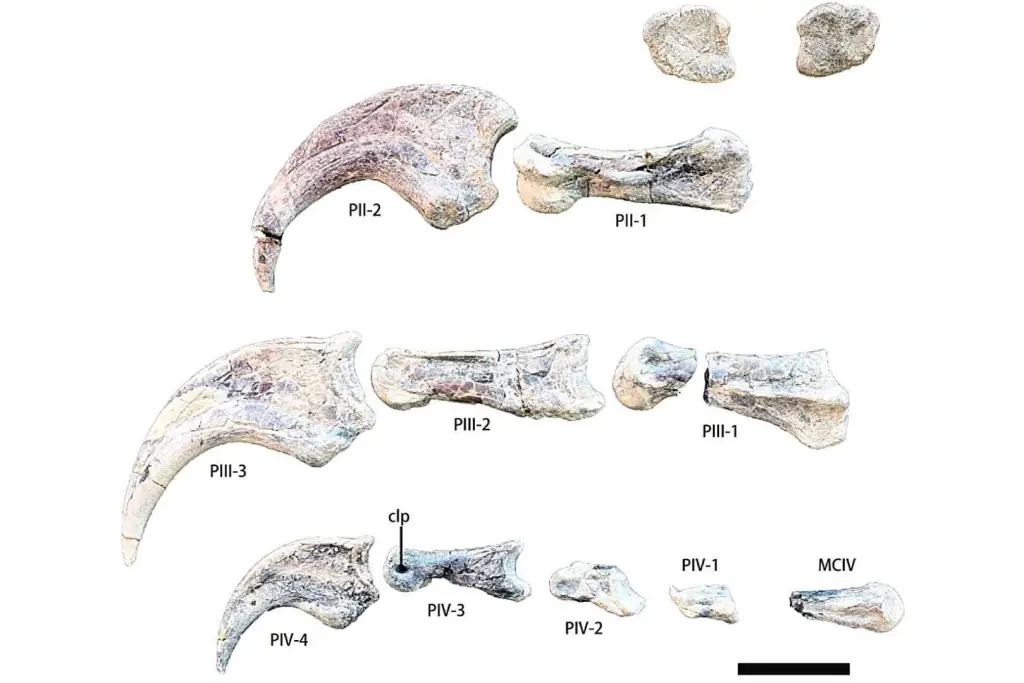
Huge claws don’t tell the whole story
This interpretation is especially interesting because it shifts attention from the therizinosaurs’ spectacular claws to the rest of their anatomy. Animals that at first glance might seem very similar perhaps exploited different resources within the same landscape.
However, important unknowns still remain. The skull of Kayrasaurus It suffered strong compression during fossilization and some elements are difficult to interpret. More importantly, the skeleton lacks hind limbs. This absence limits reconstructions of their locomotion and also introduces uncertainty in body mass estimates.
The researchers themselves consider that the proposed ecological differences will have to be tested with new fossils and more complete analyses. The fact that the specimen was probably an immature individual also forces us to assess which characteristics really correspond to the species and which could have changed during its growth.
Even with these cautions, Kayrasaurus changliensis reveals that the diversity of early therizinosaurs was greater than previously known fossils suggested. Animals of different sizes and proportions coexisted in the same ecosystem and apparently were experimenting with different ways of obtaining food. And the largest of them all, at least among those found so far in Jehol, had not yet finished growing when it was buried more than 120 million years ago.
