
Two human bones recovered from the bottom of the Penghu Canal offer an unexpected picture of the Denisovans. A preliminary study attributes a large femur and tibia, named Penghu 2 and Penghu 3, to this extinct lineage.
According to estimates, its individuals could have measured around 1.80 and 1.90 meters and weighed approximately 83 and 91 kilos, respectively. The dimensions of both fossils are among the largest known for the genus. Homo during the Pleistocene, although the sample is too small to know if this constitution was common among the Denisovans.
A protein-based identification
Identification has not been based on DNA, which is difficult to preserve in warm and humid environments, but on paleoproteomics. Researchers analyzed ancient proteins preserved in bone collagen and detected the COL1A2 R996K variantcharacteristic of the Denisovans and different from that usual in Neanderthals and modern humans.
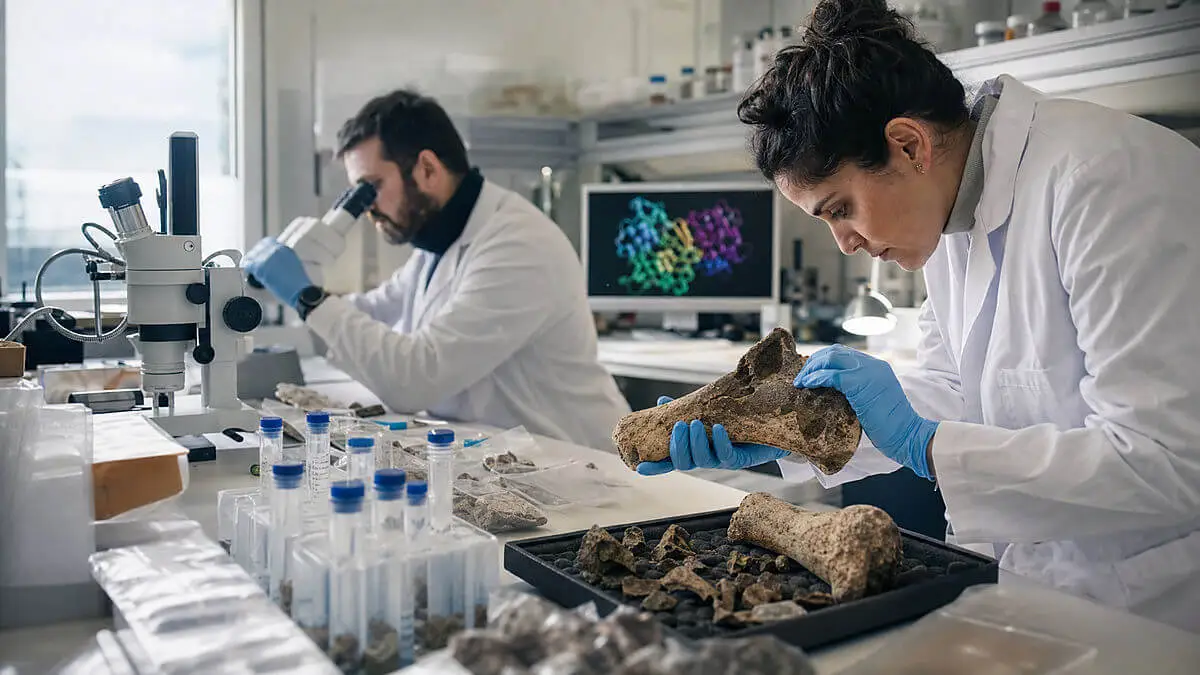
The remains come from the seabed of the Penghu channel, where the Penghu 1 jaw also appeared, identified in 2025 as belonging to a Denisovan male. The new discovery expands the scarce fossil record available to understand the anatomy of these archaic humans. The jaw and the two bones provide different evidence: the attribution of Penghu 2 and Penghu 3 is supported by the analysis of proteins conserved in collagen.
An exceptionally robust constitution
Penghu 3 has been dated to around 45,000 years ago. Isotopic analyzes further suggest that its diet contained a high proportion of animal protein and that it lived in an open landscape dominated by C4 plants. These clues offer information about the environment and diet of that individual, but they do not allow us to generalize its characteristics to the entire lineage.
The dimensions of both bones are among the largest known for the genus. Homo during the Pleistocene. However, the data invite caution: only two individuals are available and the fossils were recovered without a precise stratigraphic context. Additionally, height and weight estimates are approximate and should be understood as calculations and not direct measurements.
For now, the remains allow us to affirm that some Denisovans were exceptionally robust, not that the entire lineage was “giant”». More fossils and evidence will be needed to determine the extent to which these two individuals represented the body diversity of the Denisovans.
For now, the remains allow us to affirm that some Denisovans were exceptionally robust, not that the entire lineage was “giant.”
