
The full Moon that appears orange behind the rooftops and, hours later, shines white high in the sky is the same Moon. What has changed is the air that its light passes through. That color is an effect of the Earth’s atmosphere, just like the red of eclipses. Its own color is gray: dark gray in the seas, ancient lava plains, and light gray in the highlands. The nuances between them are so subtle that only space probes can distinguish them.
The full Moon appears orange near the horizon: its light passes through more atmosphere and loses part of the blue tones along the way. POT
Why does the Moon look orange near the horizon?
When the Moon is low, its light travels a much longer stretch of atmosphere than when it is high. On this path, the short wavelengths, the bluish ones, are dispersed more and reach our eyes less, so the long ones predominate: yellow, orange and reddish. NASA explains it this way and adds that dust or pollution can intensify the reddish tone. It is the same mechanism that colors sunrises and sunsets.
That’s why the color changes from one night to the next. The tone of the low Moon says more about the air above you than about the Moon itself: on a clear night it usually turns yellowish, and a day of haze or smoke from a fire turns it intense orange.
The red moon of eclipses
During a total lunar eclipse, the Earth comes between the Sun and the Moon, but the satellite does not disappear: it usually turns red, a phenomenon popularly called “Blood Moon.” According to NASA, it happens because the only sunlight that then reaches the Moon is that which has passed through the Earth’s atmosphere. The air disperses the blue part and lets the red, orange and yellow pass through. The more dust or clouds there are in the atmosphere during the eclipse, the redder it appears. The agency summarizes it with an image: it is as if all the sunrises and sunsets in the world were projected at the same time on the Moon.
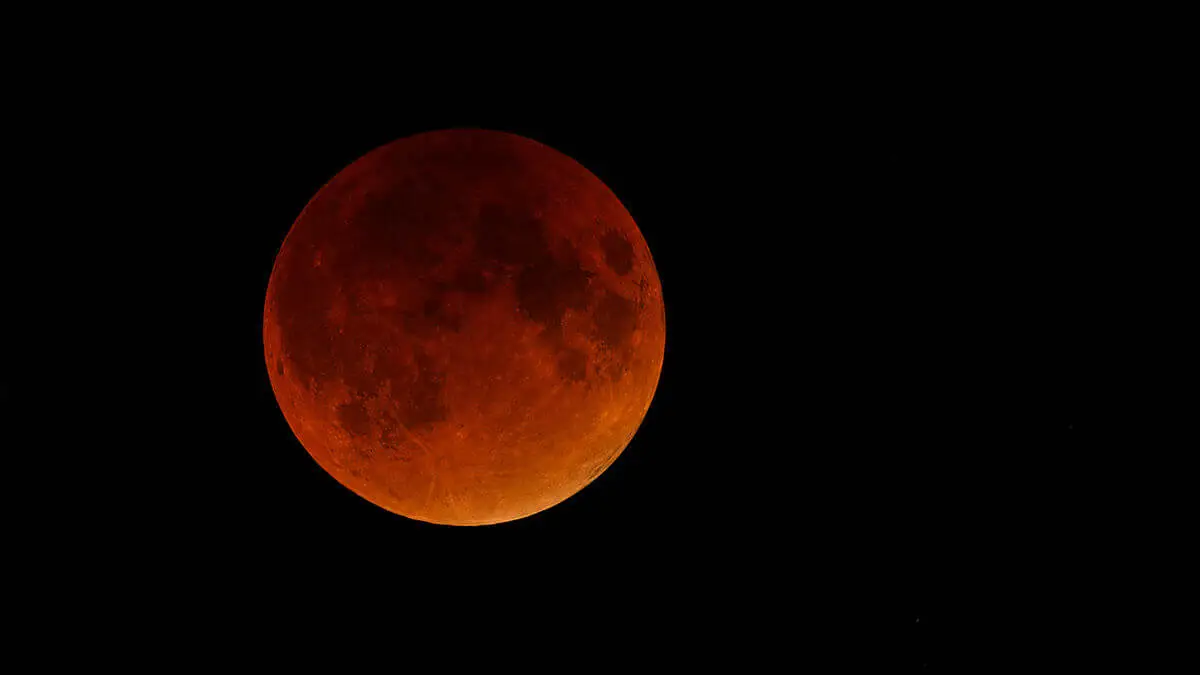
During a total eclipse, the Moon turns red with sunlight that has passed through the Earth’s atmosphere. AI
The colors of the Moon
You just have to look at the disk carefully to distinguish two types of terrain. The dark spots are the seas, which have no water: they are ancient basaltic lava flows, rich in iron and titanium. The light areas are the highlands, the oldest crust of the satellite, formed mainly by a light rock called anorthosite. Samples of basalt from the seas brought to Earth are between 3.1 and 3.8 billion years old, according to planetary geologist David A. Rothery of the Open University.
The contrast between dark seas and light highlands is the real color difference that anyone can see with the naked eye. Beyond that, the differences are so small that the eye cannot see them even with a telescope: instruments are needed to distinguish minerals.
Images of intense colors
You may have seen maps of the Moon in deep blues, oranges, and purples. They are exaggerated color images: they take minimal color differences and amplify them so that they can be seen.
One of the best-known examples is the mosaic taken by NASA’s Galileo probe in December 1992, on its way to Jupiter. In that image, according to the Jet Propulsion Laboratory (JPL), the highlands appear red due to their low titanium and iron content, and the bluest seas are the richest in titanium. The same reading applies to a composition photographed from Earth by astrophotographer Johannes Schedler, which NASA chose as the astronomical image of the day on February 16, 2006. According to his explanation, these differences have been calibrated with the rocks brought back by the Apollo missions.
That color key is valid for those images, not for all. The animation Invisible Colors of the Moonwhich NASA published in 2009 with data from the Moon Mineralogy Mapper, a NASA instrument aboard the Indian probe Chandrayaan-1, assigns different combinations of bands to the red, green and blue channels. That instrument measured light between 0.45 and 3 micrometers, well within the infrared, when our eyes only capture between 0.4 and 0.75. In these images, color is a way of representing measurements.
Seven bands to map the Moon
The wide-angle camera of the Lunar Reconnaissance Orbiter probe, in lunar orbit since 2009, photographs the satellite through seven filters: two in the ultraviolet, centered at 321 and 360 nanometers, and five in the visible, at 415, 566, 604, 643 and 689 nanometers. With them, the camera team at Arizona State University has created mosaics of almost the entire surface that allow us to compare how each terrain reflects light and deduce its composition.
How to observe the colors of the Moon with the naked eye
No need for a telescope. Just a little observation is enough:
-
Compare seas and highlands. On any clear night, look at the dark spots and the light areas: they are the two large geological units of the Moon.
-
Follow the Moon since it rises. Observe it when it is low and note its tone; Look at it again an hour or two later, now taller, and see if it has become whiter.
-
Repeat on different nights. If the low Moon looks redder one night than another, what you are recording are changes in the atmosphere, such as dust, humidity or smoke.
What is seen like this is the effect of the Earth’s atmosphere and the great geological contrast of the satellite. Knowing what minerals are in each area continues to be the work of the probes, whose measurements are compared with samples from the Apollo missions.
References
-
NASA Science. “The Moon Illusion: Why Does the Moon Look So Big Sometimes?” science.nasa.gov
-
POT. “What You Need to Know about the Lunar Eclipse.” moon.nasa.gov
-
NASA/JPL. “PIA00129: Moon – False Color Mosaic”, Galileo probe, 1992. photojournal.jpl.nasa.gov
-
Nemiroff, R.; Bonnell, J. (eds.). “The Color of the Moon”, Astronomy Picture of the Day, February 16, 2006. Image by Johannes Schedler. apod.nasa.gov
-
ISRO/NASA/JPL-Caltech/Brown University. “PIA12238: Invisible Colors of the Moon”, 2009. science.nasa.gov
-
Lunar Reconnaissance Orbiter Camera, Arizona State University. Technical specifications. lroc.asu.edu
-
Rothery, DA “The Moon”, OpenLearn, Open University. open.edu