
Close your eyes and try to see a red apple. Most people conjure up something: a shape, a color, a shine. For a part of the population that image does not appear, no matter how hard they try. However, many of these people say that at night they do dream of visual scenes. The most cited explanation is that imagining at will and dreaming depend on different brain mechanisms, although other studies suggest that aphantasia also affects dreams.
Person with eyes closed trying to see a mental image, the gesture with which aphantasia is tested. AI
What is aphantasia
Aphantasia is the inability, total or almost total, to generate visual images at will. The term was coined in 2015 by neurologist Adam Zeman, from the University of Exeter School of Medicine, Michaela Dewar and Sergio Della Sala, in a letter to the magazine cortex in which they described 21 people they had never been able to see. They took it from phantasiathe word by which Aristotle referred to the “mind’s eye.”
Aphantasia has nothing to do with intelligence or creativity. In their 2020 work, Zeman’s team cites geneticist Craig Venter and neurologist Oliver Sacks as examples of people with aphantasia and high imaginative capacity. The authors clarify that they do not consider it a medical disorder, but rather a variation of human experience comparable to synesthesia. Nor does it have to be limited to sight: 54.2% of its participants with aphantasia said they did not have mental images in any sense, while the rest retained some, especially hearing.
Regarding its frequency, in a sample of 1,288 volunteers from the EXTEND biobank in Exeter, 0.7% obtained the lowest possible score on the visual imagination questionnaire, and 2.6% fell within the range that the team considers aphantasia.
How many people with aphantasia dream about images
The 2020 study gathered questionnaires from 2,000 people with aphantasia who had contacted the team between June 2015 and March 2018, after learning about the research in the media. They compared them to 200 people with hyperfantasy (mental images as vivid as real seeing) and 200 with average-level imagination. To classify them they used a version of the Vividness of Visual Imagery Questionnaire (VVIQ), in which each person rates the vividness of what they imagine on a scale of 16 to 80. Aphantasia corresponded to scores of 16 to 23.
63.4% of participants with aphantasia reported dreaming about images. 20.7% said they dreamed without them and 7.5% said they did not dream. In the medium level group, the percentages were 89%, 6.5% and 0.5%, and in the hyperfantasy group, 98.5%, 0.5% and 0%. Those who dreamed without images described dreams made of stories, text, ideas, sounds and emotions.
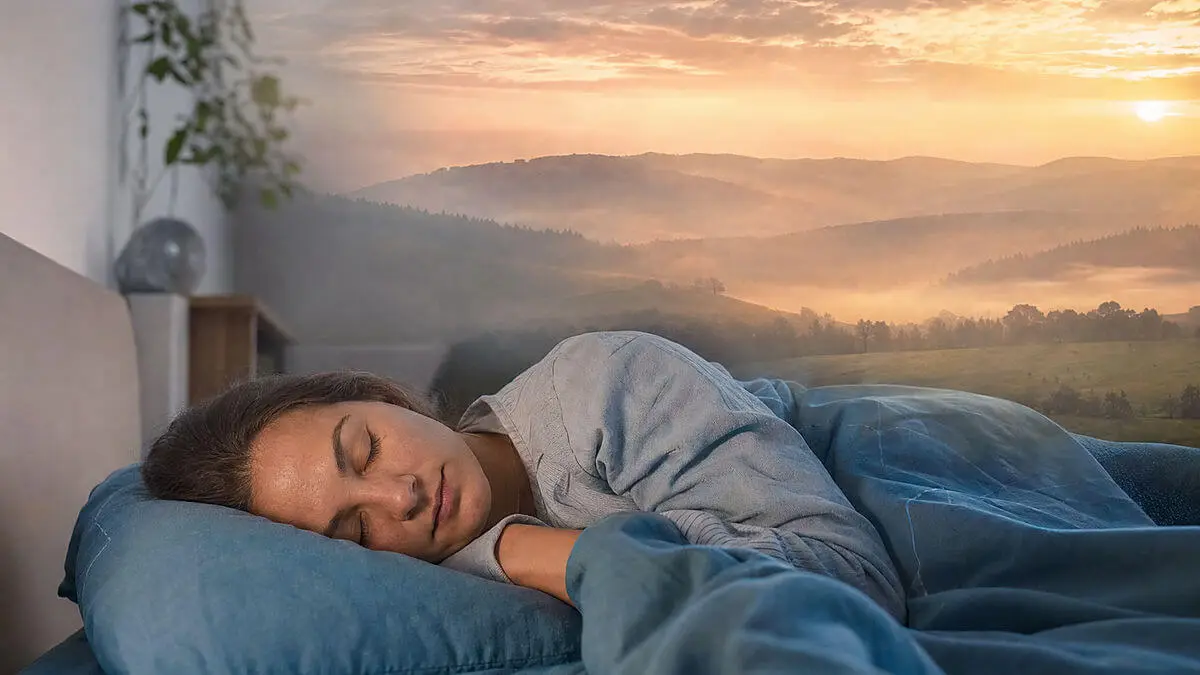
Dream scene about a sleeping person: almost two out of three people with aphantasia say they dream with images. AI
Why they can dream about images: two explanations
The first is proposed by Zeman and his colleagues. Imagining at will is a “top-down” process, depending on control networks in the frontal and parietal cortices. Dreaming is a “bottom-up” process, originating in the brain stem. If what fails in aphantasia is the voluntary control of images, dreams could be preserved, because they do not need anyone to summon them. The study raises this explanation, but does not test it.
The second comes from another study. In 2020, Alexei Dawes, Rebecca Keogh, Thomas Andrillon and Joel Pearson, from the University of New South Wales (Sydney), compared 267 people with aphantasia with two control groups of 203 and 197 people, in a work published in Scientific Reports. Those with aphantasia reported dreaming less frequently, and their dreams were less vivid and with less sensory detail. For Pearson, this indicates that the lack of images also affects involuntary processes such as dreaming, although it does not cancel them. The same work found an exception: spatial imagination (locating objects and distances) was similar in the three groups, also in dreams.
The two explanations may be compatible: many people with aphantasia retain images in dreams, but, on average, less than the rest.

Person who wakes up in the morning: what we know about these dreams comes from what each person remembers when they wake up. AI
Each person, their own pattern
In June 2026, Derek H. Arnold and Loren N. Bouyer of the University of Queensland, Australia, and Merlin Monzel of the University of Bonn, Germany, published in Scientific Reports the first analysis of the senses present in the dreams of people with aphantasia. They compared 84 people with visual aphantasia to a group of 121 people without it. To classify them, they used a questionnaire that measures imagination in various senses, and between 12% and 26% of the group with visual aphantasia said they imagined with some clarity other senses, such as movement or smell.
Each participant responded consistently, but the relationship between dreams and waking imagination varied greatly from person to person. For some, their dreams reflected what they could imagine when awake; In others, there was hardly any relationship. That’s why there is no single answer to “why”: it depends on each person.
What is still not known
All of this data comes from what each person remembers and tells about their dreams, not from a measurement during sleep. The authors of the study cortex recognize that participants volunteered, so may not represent all people with aphantasia, and that the VVIQ is a questionnaire, not a diagnosis. That is why they ask to contrast these results with objective measures of behavior and brain activity. The next step is to study in the laboratory what happens in the brain of a person with aphantasia while they dream, and thus check which of the two explanations holds.
References
-
Zeman, A., Dewar, M., and Della Sala, S. (2015). Lives without imagery – Congenital aphantasia. cortex73, 378-380. doi.org/10.1016/j.cortex.2015.05.019
-
Zeman, A., Milton, F., Della Sala, S., Dewar, M., Frayling, T., Gaddum, J., Hattersley, A., Heuerman-Williamson, B., Jones, K., MacKisack, M., and Winlove, C. (2020). Phantasia – The psychological significance of lifelong visual imagery vividness extremes. cortex130, 426-440. doi.org/10.1016/j.cortex.2020.04.003
-
Dawes, A.J., Keogh, R., Andrillon, T., & Pearson, J. (2020). A cognitive profile of multi-sensory imagery, memory and dreaming in aphantasia. Scientific Reports10, 10022. doi.org/10.1038/s41598-020-65705-7
-
Arnold, D.H., Bouyer, L.N., & Monzel, M. (2026). Heterogeneous relationships between the multisensory content of aphantasics’ dreams and their volitional waking imagined experiences. Scientific Reports16, 32998. doi.org/10.1038/s41598-026-56386-9