
Yes, sharks are older than trees. The oldest fossils safely attributed to its lineage are teeth, scales and fin spines found in the Chinese province of Guizhou. They are about 439 million years old, according to two studies published in Nature in 2022. The oldest known fossil forest, on the cliffs of Somerset and Devon in southwestern England, is about 390 million. There is almost 50 million years difference between them.
A modern-day shark swims next to a forested coast: the question compares two lineages whose earliest known fossils are separated by almost 50 million years. AI-generated recreation
Those first relatives of sharks were small fish, with spines on their fins and, in some cases, armor plates. Today’s sharks are the result of a long subsequent evolution. That’s why the answer depends on what you mean by “shark” and by “tree.”
What counts as a shark and what as a tree
Chondrichthyans are fish with a cartilaginous skeleton: today, sharks, rays and chimeras. Its oldest fossils belong to the so-called trunk branch of the group. They are animals related to that lineage, but before the appearance of the current species. In the popular phrase, “shark” is used in this broad sense.
“Tree,” on the other hand, does not name a kinship group. It describes a way of growing: a tall, reinforced trunk that supports branches. This architecture appeared in different groups of plants during the Devonian, the period from 419 to 358 million years ago. The question actually compares the antiquity of an animal lineage with the first time a form of plant growth is documented.
How to date a fossil
Paleontologists rarely date the fossil itself: they date the rock that contains it. Sometimes they measure the decay of radioactive elements in volcanic ash or in minerals from nearby layers. Others turn to guide fossils, widespread, short-lived species whose age is already known. This is how it was dated Fanjingshania renovataone of the Guizhou species: the conodonts in its same layer, tiny extinct marine animals that serve as a geological clock, place it at 439 million years ago.
That date is also a minimum age. It shows that the animal already existed then, not that its lineage was born at that time.
Evidence from the sharks
The oldest track is also the most discussed. In 1996, Ivan Sansom, Moya Smith and Paul Smith described in Nature some flakes from the Harding sandstone, in Colorado (United States), from the Upper Ordovician, which they interpreted as possible shark scales. With them, the group’s record went back about 25 million years, to about 455 million years ago. But they are loose scales, and without a skeleton their attribution remains open.
Firm evidence came in September 2022, with four articles in Nature on fish from the lower Silurian of China. The team of Plamen Andreev, Ivan Sansom of the University of Birmingham, and Min Zhu of the Chinese Academy of Sciences described Qianodus duplicis. It is a species known for its tooth spirals, about 439 million years old: the oldest teeth of a jawed vertebrate, 14 million years older than the previous record. The same team presented Fanjingshania renovataknown for plates, scales and fin spines, which the analysis places in the chondrichthyan branch.
A third study, led by You-an Zhu, revealed a site in Chongqing from about 436 million years ago with full-bodied fish. Until then, the oldest complete jawed fish numbered about 425 million. Among the new ones is Shenacanthus vermiformisa chondrichthyan with a body shape similar to others in its group, but with armor plates.
Before these findings, the reference was Doliodus problematicusfrom New Brunswick (Canada). Randall Miller, Richard Cloutier and Susan Turner described it in 2003 as the oldest known articulated chondrichthyan, almost 409 million years old. It retains the teeth in place, part of the skull and a pair of spines on the pectoral fins.
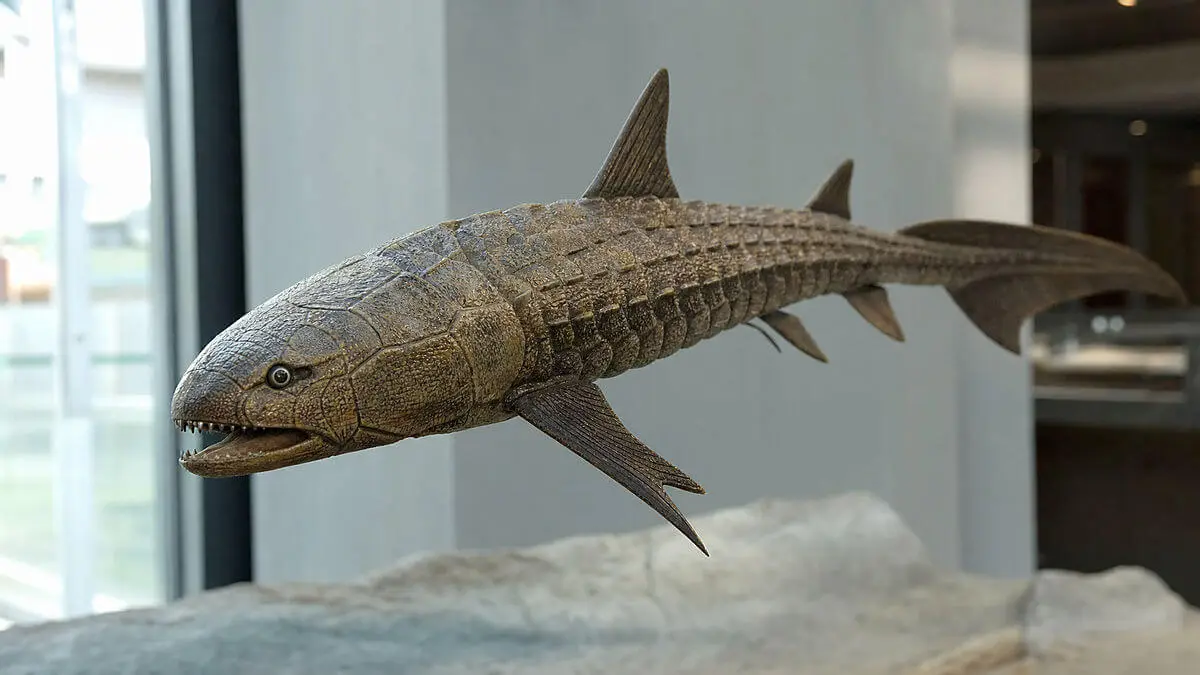
Reconstruction of Shenacanthus vermiformis, a relative of sharks that lived about 436 million years ago and was found complete in Chongqing, China. Heming Zhang
Tests from the side of the trees
In 2024, Neil Davies and William McMahon of the University of Cambridge and Christopher Berry of Cardiff University described in the Journal of the Geological Society fossilized trunks in their living position. They are in the Hangman Sandstone formation, near Minehead. They are about 390 million years old, from the Middle Devonian. It is the oldest known evidence of standing trees in the place where they grew, which is what defines a fossil forest, and is about 4 million years older than the previous record, in New York state.
Those trees, of the genus Calamophytonreminded at first glance of a palm tree. Their trunks were thin and hollow, they had no leaves and their branches were covered with hundreds of twigs. The largest measured between two and four meters. Like any fossil, this forest marks a minimum age: there could have been somewhat earlier trees that have not been preserved or have not been found.
What remains to be known
For the answer to change, trees almost 50 million years older than those in Somerset would have to be found, already in the middle of the Silurian. On the shark side, research points in the other direction. According to the authors of the Chinese studies, their findings are the best support so far for the idea that jawed vertebrates were already diversifying in the early Silurian, long before they became abundant in the Early Devonian record. If skeletons arrive that confirm the Colorado scales, the difference will grow.
References
-
– Sansom, I. J.; Smith, M.M.; Smith, M. P. (1996). “Scales of thelodont and shark-like fishes from the Ordovician of Colorado.” Nature379, 628-630. doi.org/10.1038/379628a0
-
– Miller, R. F.; Cloutier, R.; Turner, S. (2003). “The oldest articulated Chondrichthyan from the Early Devonian period.” Nature425, 501-504. doi.org/10.1038/nature02001
-
– Zhu, Y. et al. (2022). “The oldest complete jawed vertebrates from the early Silurian of China.” Nature609, 954-958. doi.org/10.1038/s41586-022-05136-8
-
– Andreev, P. S. et al. (2022). “The oldest gnathostome teeth.” Nature609, 964-968. doi.org/10.1038/s41586-022-05166-2
-
– Andreev, P. S. et al. (2022). “Spiny chondrichthyan from the lower Silurian of South China.” Nature609, 969-974. doi.org/10.1038/s41586-022-05233-8
-
-Davies, N. S.; McMahon, W.J.; Berry, C. M. (2024). “Earth’s earliest forest: fossilized trees and vegetation-induced sedimentary structures from the Middle Devonian (Eifelian) Hangman Sandstone Formation, Somerset and Devon, SW England.” Journal of the Geological Society. doi.org/10.1144/jgs2023-204