
You just have to try it once to understand it. A handful of cattail leaves, two hands, a constant twisting movement and, in just a few minutes, breaks, loosening ropes and a meter of irregular rope. Making twine is not a trivial task, and that difficulty hides one of the worst-told stories of prehistory.
A scene in a makeshift laboratory
In experimental archaeology, reproducing a prehistoric rope requires much more than twisting fibers: you have to select the right plant, separate the fibers without destroying them, control humidity, and maintain a stable twist throughout the process. One carelessness and the whole thing falls apart. It is important to distinguish two things that are often confused: productthe finished rope, and the processthe chain of technical decisions that make it possible.
That process hardly leaves a trace. Plant fibers, leather, wood and tendons decompose and rarely reach us. The archaeological record is, therefore, biased towards what survives, the stone, not towards what was most used. This report follows those who reconstruct these techniques to measure their true cost in time, skill and cooperation, always separating what we know from what we only infer.
Fiber, thread, twine, rope and fabric: a grammar of fibers
To read the evidence you need a precise vocabulary. A fiber It is a plant or animal unit; several aligned fibers form a thread; several twisted threads produce a string; several cords combined constitute a rope; and a mesh of intertwined elements forms a tissue. The resistance does not come from the material itself, but from a simple physical principle: twisting in opposite directions. When the ropes are twisted in one direction and then combined in the opposite direction, the tension of each element pulls against that of the others, distributing the load and preventing the whole from falling apart. It’s the same trick that holds a modern rope.
Each category opens up a range of plausible uses. A cord allows tools to be hafted, that is, to attach a stone point to a wooden shaft; small animals or fish are hunted with nets and traps; ropes secure loads, allow objects to be dragged or lifted, and help set up shelters; The finer threads are used to sew skins, and the meshes make bags. None of this is carved in stone, but all of it could articulate daily life, from hunting to transportation, clothing or access to difficult places.
How to read a fingerprint that almost does not exist
A methodological warning is in order: information on fiber technologies arrives through four different routes, and confusing them impoverishes the argument. The first is the direct evidencea preserved cord that we can analyze. The second, the experimental reconstructionshows that a technique is viable, but not that it was executed this way in prehistory. The third, the ethnographic analogyillustrates potential costs from current societies, without implying “same culture, same gesture.” And the fourth, the archaeological inferencededuces the use of perishable materials from functional marks on the stone, with probability but without certainty. A mental traffic light helps: direct, viable, indicative, inferred. Keeping those labels separate is what distinguishes a solid hypothesis from a “caveman” fantasy.
Hohle Fels: the possible rope from more than 35,000 years ago
An almost complete mammoth ivory instrument was recovered from the Hohle Fels cave in Germany. 20.4 centimeterswith four perforations and carefully crafted helical grooves. It comes from an Aurignacian context of more than 35,000 years and has been interpreted by Nicholas Conard and Veerle Rots as a tool for twisting fibers.
It is worth clarifying: the form suggests a function, but does not demonstrate it on its own. The researchers built replicas and put them to the test: with cattail fibers and the participation of four or five people, the device typically produced 5 meters of strong rope in 10 minutesabout 0.5 meters per minute. It is an experimental measurement, not a speed automatically attributable to the Aurignacian groups. The most interesting thing is not the figure, but what the object implies: it was not just about inventing a rope, but about designing a device capable of coordinating several hands and stabilizing a complex operation.

Abri du Maras: direct evidence of Neanderthal technology
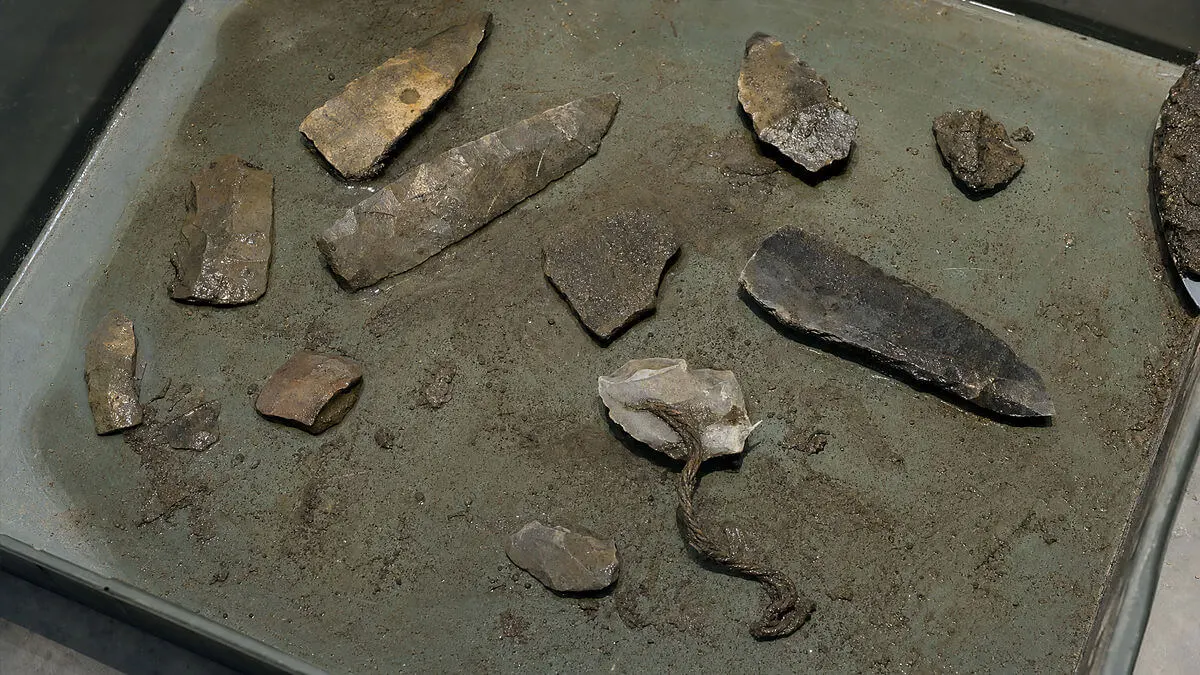
If Hohle Fels offers a tool, Abri du Maras offers the positive test. At this site in southeastern France, a fragment of plant cord remained attached to the underside of a recovered Levallois flake on site at level 4.2 of the Middle Paleolithic. The sediment that covered the piece and the absence of subsequent alteration support that the cord and flake entered the deposit together.
The chronology deserves precision: the level presents ESR/U-series dating of approximately 41 ± 2, 46 ± 5 and 52 ± 2 thousand yearsso it is more rigorous to speak of an interval of about 41,000 to 52,000 years than a single round date. The cord is made up of three twisted ends and constitutes direct evidence of fiber technology associated with Neanderthals. Its manufacture involved, at a minimum, obtaining and preparing plant fibers, twisting them and combining various elements into a resistant structure. According to Bruce Hardy’s team, this sequence points to technical planning and knowledge of raw materials. Now, the cord does not say who carried out the task or how the work was distributed: those questions remain open.
From the harness to the rope: a very old technology
Fiber technology doesn’t come out of nowhere with these laces. Use marks, impact fractures and wear patterns on some lithic assemblages from France and the Netherlands point to tools composed and hafted much earlier. In Maastricht-Belvédère, in the Netherlands, the evidence falls between 250,000 and 270,000 years; in Biache-Saint-Vaast, France, an interval of between 175,000 and 240,000 years. No rope survives and the binding material cannot be positively identified, but these functional clues suggest handles, shafts and perishable ties. It is an inference, not direct proof, and that is why it should be treated as a solid clue rather than as a closed fact.
How much work does invisible technology cost?
Here the ethnographic analogy comes in, with all its cautions. Among the Wola of the Southern Highlands of Papua New Guinea, documented by Paul Sillitoe, making the rope needed for a bag requires 14 hours collection, separation and drying of raw materials, plus 65 to 80 hours of twisting to prepare the cords. And those figures don’t include the final braiding of the bag, which can add another 100 to 160 hours.
None of these hours directly describe the labor economy of Neanderthals or European hunter-gatherers. They serve, however, to measure the potential effort of a technology that barely left a trace: behind each preserved cord there could have been entire days of work, and probably several coordinated hands. The invisibility of the material does not equate to ease or marginality; rather it suggests the opposite.
Rewrite the story of prehistory
The traditional image of prehistory was built on what endures, the carved stone, and minimized what decomposes. But ropes, nets, bags and ties could have been as decisive as the stone tools: without them there is no effective hauling, no transport of loads, no storage, nor much of the hunting with traps. Recognizing this invisible technology is not an ornament, but a fundamental correction in how we understand the daily lives of our ancestors and Neanderthals.
Hohle Fels, Abri du Maras and the signs of hauling draw, each with its level of certainty, an ancient, planned and shared technical capacity. The next time someone tries to twist a handful of fibers and watches them fall apart in their fingers, they may better understand why this story finally deserved to be told.